John was showing how to put on broad simple washes and then how to build up over the top.
Arts in Provence
ARTS IN PROVENCE
Welcome to the Arts in Provence Blog. This is a blog about life in Les Bassacs, a small hamlet in the South of France, where we organise summer painting courses. You can find out about the courses by going to our website.
Sunday, May 8, 2011
John's demonstration paintings
Here are some quick watercolour landscape demonstrations that John did for the group this week.

John was showing how to put on broad simple washes and then how to build up over the top.
Wednesday, May 4, 2011
Ratatouille
I made a mountain of ratatouille this afternoon for this evening's meal. It is a dish which should be very simple, and when the balance of flavours are right, it is utterly delicious.
Today, I used the ratatouille recipe from The Provencal Cookbook by Guy Gedda. This is a great cookbook by a great chef, and anything that I have cooked from it has always turned out incredibly tasty, with a really authentic Provençal flavour.
Monday, May 2, 2011
First week of the season
This is the first week of the Les Bassacs season 2011.
The countryside is lush, verdant and full of wild flowers, the sun is shining and the cicadas are making a few tentative chirps.
Dibbs has come to help us out for a second season and has made the transition into work feel much easier. John Raynes is teaching this week, there are many old friends here and today the group were painting in Saignon . . .Thursday, April 14, 2011
Wild Narcissi
![]() |
| Field of wild narcissi near Les Bassacs |
In common with most of Europe we have had an exceptionally warm spring and the air is heavy with the smell of blossom. The cherry blossom came and went very quickly, so ripe cherries should be with us in 6 weeks or so. I spotted this new field of narcissi between us and St Saturnin les Apt.
| Triandrus Poeticus |
I have to really resist the temptation to pick armfuls of the sweetly scented flowers. They are wild to this part of western Europe and once established, proliferate easily in the slightly marshy spring-fed ground, usually under the fruit trees. This variety is known as the Poet's narcissus or in French, Jeannette Blanche
Saturday, March 26, 2011
Toad Invasion
You really know that spring has arrived when your pond is invaded by toads. Last year we had so many and they laid so much spawn that it killed our fish. This year we were on toad watch. As soon as we saw the familiar movement in the water, David went out with a large net and netted 20 toads, apparently 10 pairs.
They are the Crapaud Commun, the common toad. They have a distinctive copper coloured eye with a horizontal pupil which enables them to see well at night. The female is larger than the male who only attains a body-length of 8cm, while a fully grown female can be 13cm.
Some of these were certainly that large. They seek out still water and ponds, usually the water into which they were spawned. Toadspawn differs from frogspawn as the eggs are laid in strings. Last year our pond was so filled with this never-ending spaghetti of toadspawn that the oxygen in the water was used up and it seems that this is why our fish died. In France the toad is a protected species. We were warned by our neighbours against touching them as in Provence they are a porte malheur - they bring bad luck, although if they cross your path, they apparently bring good luck!
We took them all down the hill to what used to be the Les Bassacs wash house, which oddly is quite a long way from the hameau, seemingly a disincentive to the residents of Les Bassacs to keep their laundry clean! It is completely overgrown with brambles now, but is a good source of water for most of the year, and we felt a better home for the toads.
On the way back up the hill we came across this orchid. A Himantoglossum Robertianum, it is the first orchid of spring and grows all over south-east France in the garrigue.
They are the Crapaud Commun, the common toad. They have a distinctive copper coloured eye with a horizontal pupil which enables them to see well at night. The female is larger than the male who only attains a body-length of 8cm, while a fully grown female can be 13cm. Some of these were certainly that large. They seek out still water and ponds, usually the water into which they were spawned. Toadspawn differs from frogspawn as the eggs are laid in strings. Last year our pond was so filled with this never-ending spaghetti of toadspawn that the oxygen in the water was used up and it seems that this is why our fish died. In France the toad is a protected species. We were warned by our neighbours against touching them as in Provence they are a porte malheur - they bring bad luck, although if they cross your path, they apparently bring good luck!
We took them all down the hill to what used to be the Les Bassacs wash house, which oddly is quite a long way from the hameau, seemingly a disincentive to the residents of Les Bassacs to keep their laundry clean! It is completely overgrown with brambles now, but is a good source of water for most of the year, and we felt a better home for the toads.
![]() |
| The toads in their new home disguising themselves as leaves |
On the way back up the hill we came across this orchid. A Himantoglossum Robertianum, it is the first orchid of spring and grows all over south-east France in the garrigue.
Sunday, March 13, 2011
David's Life Drawing
During the winter I regularly go to a life drawing studio at the "Ancienne Hopital" in Apt - it's the original old hospital that has been converted to house various activities, including the music school. For the last 18 years or so a group have met in a room at the top of the building to draw from a model. It's organised by Mario Roffler, a Swiss artist who lives just outside the town.
I first went there a year after the group started up, and after a long break (10 years!) started going along again last year. I wasn't surprised to find that some of the original group were still going - and Mario as always sat in 'his' place. Even some of the same models are still posing. The atmosphere is very informal, anyone can just turn up and pay 5 euros. There is no teaching, which suits me.
It is an excuse to draw for a couple of hours. I don't have any particular aim in mind, I switch off and draw.
I only take along a piece of charcoal or a 3B pencil and white cartridge paper so as not to get bogged down with technique. None of the poses are very long, 20 - 25 minutes maximum, which is plenty.
The drawings are not finished pieces, but are stored in a large folder - I am only really interested in the process of looking and drawing. Sometimes I might focus on something specific like quality of line, or exploring volume, but usually I try not to think too much.
There really is a great pleasure in drawing - there is an appealing purity in excluding complications like colour, and just looking and responding. It's a kind of meditation once you get past the resistance to starting.
I first went there a year after the group started up, and after a long break (10 years!) started going along again last year. I wasn't surprised to find that some of the original group were still going - and Mario as always sat in 'his' place. Even some of the same models are still posing. The atmosphere is very informal, anyone can just turn up and pay 5 euros. There is no teaching, which suits me.
It is an excuse to draw for a couple of hours. I don't have any particular aim in mind, I switch off and draw.
I only take along a piece of charcoal or a 3B pencil and white cartridge paper so as not to get bogged down with technique. None of the poses are very long, 20 - 25 minutes maximum, which is plenty.
The drawings are not finished pieces, but are stored in a large folder - I am only really interested in the process of looking and drawing. Sometimes I might focus on something specific like quality of line, or exploring volume, but usually I try not to think too much.
There really is a great pleasure in drawing - there is an appealing purity in excluding complications like colour, and just looking and responding. It's a kind of meditation once you get past the resistance to starting.
Monday, March 7, 2011
Almonds in Provence
There are many traditional almond deserts and sweets including Calisson from Aix-en-Provence - a mixture of almonds and glacé melon, Dragee which are given away as a symbol of purity at christenings and as a blessing at Provençal weddings and the Délice de l'Amandier from Mont Ventoux which is a flour-less almond cake.
When we first moved here there was a boulangerie in Apt which made a delicious almond and glacé cherry Madeleine. They cost a fortune, so were only an occasional indulgence! The boulanger told me they were a traditional Apt cake. I guess that with the glacé fruit business being so dominant here, you would expect it to creep into the food somehow. The boulanger is long-gone, but a bit like Proust's Madeleine moment, I haven't forgotten the delicious taste of his cakes and I often bake these at Easter as a treat.
Little Almond Cakes
115g softened salted butter
150g caster sugar
3 large eggs
85g ground almonds
45g plain flour
a good sprinkling of almond essence
40g roughly chopped glace cherries
Preheat the oven to 180C, gas mark 4 and liberally butter a tray of madeleine moulds or get ready 8 cup cake paper cases.
Beat the butter until pale and soft.
Gradually add the sugar, beating until pale and fluffy.
Beat in each egg, making sure that the egg is well incorporated before adding another.
Fold in the almonds, almond essence and cherries.
Sift the flour and gently fold into the mixture.
Spoon into the madeleine moulds or paper cases, making sure not to overfill them.
Bake for about 20 minutes, until springy and golden.
Turn out on to a cooling rack and dust with caster sugar.
When we first moved here there was a boulangerie in Apt which made a delicious almond and glacé cherry Madeleine. They cost a fortune, so were only an occasional indulgence! The boulanger told me they were a traditional Apt cake. I guess that with the glacé fruit business being so dominant here, you would expect it to creep into the food somehow. The boulanger is long-gone, but a bit like Proust's Madeleine moment, I haven't forgotten the delicious taste of his cakes and I often bake these at Easter as a treat.
Little Almond Cakes
| David photographed these before they went. |
150g caster sugar
3 large eggs
85g ground almonds
45g plain flour
a good sprinkling of almond essence
40g roughly chopped glace cherries
Preheat the oven to 180C, gas mark 4 and liberally butter a tray of madeleine moulds or get ready 8 cup cake paper cases.
Beat the butter until pale and soft.
Gradually add the sugar, beating until pale and fluffy.
Beat in each egg, making sure that the egg is well incorporated before adding another.
Fold in the almonds, almond essence and cherries.
Sift the flour and gently fold into the mixture.
Spoon into the madeleine moulds or paper cases, making sure not to overfill them.
Bake for about 20 minutes, until springy and golden.
Turn out on to a cooling rack and dust with caster sugar.
Sunday, March 6, 2011
Almond Blossom
At last there are hints of spring in the hedgerows as the almond blossom starts to appear. This is relatively late for us, sometimes by the end of January the almonds at the end of the road have already flowered and shed their petals.
David went out this afternoon to photograph the trees on the edge of the hameau. At the end of the 19th century Provence was the world's largest producer of almonds, and they are reckoned to be the best and the sweetest - by the Provençeaux!
Although there are few almond orchards now, there are still the remnants to be found on the edges of the fields and bordering the roads, they signify the longer days and warmer weather that are on their way, and I know that it is only a matter of weeks until the cherries come into flower.
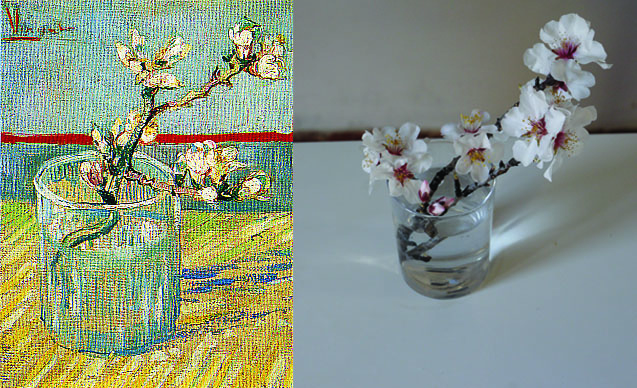
We were reminded of our visit last spring to the asylum at St Remy where Van Gogh was incarcerated in 1889 and 1890 and the beautiful gardens that he painted in. Van Gogh had arrived in a snowy, icy Arles in February 1888 and, unable to paint outside, he picked some almond blossom and painted this still life in his hotel room.
As soon as the snow melted he went out into the countryside to capture the blossom against the strong blue skies, and painted fourteen orchards in his first month there.
On January 31st 1890 Van Gogh painted 'Almond Blossom', in celebration of the birth of his brother Theo's son.
He writes to his mother " how glad I was when news came that it had ended well . . . I started right away to make a picture for him, to hang in their bedroom, big branches of white almond blossom against a blue sky . . ."
David went out this afternoon to photograph the trees on the edge of the hameau. At the end of the 19th century Provence was the world's largest producer of almonds, and they are reckoned to be the best and the sweetest - by the Provençeaux!
Although there are few almond orchards now, there are still the remnants to be found on the edges of the fields and bordering the roads, they signify the longer days and warmer weather that are on their way, and I know that it is only a matter of weeks until the cherries come into flower.
We were reminded of our visit last spring to the asylum at St Remy where Van Gogh was incarcerated in 1889 and 1890 and the beautiful gardens that he painted in. Van Gogh had arrived in a snowy, icy Arles in February 1888 and, unable to paint outside, he picked some almond blossom and painted this still life in his hotel room.
![]() | |
| Blossoming Almond Branch in a Glass by Van Gogh 1888 & David's homage to Van Gogh 2011 |
As soon as the snow melted he went out into the countryside to capture the blossom against the strong blue skies, and painted fourteen orchards in his first month there.
On January 31st 1890 Van Gogh painted 'Almond Blossom', in celebration of the birth of his brother Theo's son.
He writes to his mother " how glad I was when news came that it had ended well . . . I started right away to make a picture for him, to hang in their bedroom, big branches of white almond blossom against a blue sky . . ."
Sunday, February 20, 2011
The Art of Watercolours
Sheila Hancock has just emailed me with this flier for her new television series which starts tonight on BBC1. I know she has spent the autumn travelling the world filming for the series which explains why she is waving at us from an elephant. It should be interesting . . .
Monday, January 17, 2011
Camargue at Christmas
At Christmas we make an annual pilgrimage to the Camargue. When the countryside is at its bleakest and we are stuffed full of the excesses of Christmas eating, we take a day to walk in this strange and invigorating landscape. Last Christmas it was raining so hard we could barely open the door of the car and in fact only managed to stagger along the beach, fearing for our lives as the rough sea battered the sand. This year, the weather was cold but dry and we were able to drive out along the dikes to a very remote beach to catch the sunset. The inland lagoons were frozen but not solid and the water was moving under the ice, making strange thick waves.
I have never seen so many birds close up, a huge number overwinter here, including sandpipers and plovers and fresh water waders such as marsh terns and herons. We came across ditches broiling with herons and cormorants as they fished in the muddy waters for eels.Of course the Camargue is famous for its flamingos and we were able to glimpse this group fighting amongst themselves. Although the lagoons look like a natural environment, they have been controlled with a system of dikes and breakwaters since the Middle Ages. The natural sediment-fed islets in the lagoons are disappearing under the water. These islets were where the flamingo population nested. Apparently, the WWF has begun a very successful programme of artificial islet construction they even provide ready-made man-made nests, which look like mud donuts!
Subscribe to:
Posts (Atom)