Arts in Provence

ARTS IN PROVENCE
Welcome to the Arts in Provence Blog. This is a blog about life in Les Bassacs, a small hamlet in the South of France, where we organise summer painting courses. You can find out about the courses by going to our website.

Tuesday, May 24, 2016

Rebecca Hind's week with David

Unfortunately Rebecca was unable to teach her course this summer at Les Bassacs.  David stepped in to take the week which meant that he dusted off his watercolours and enjoyed the freedom to experiment in his sketch book.


Rustrel


St Saturnin les Apt


On picnic day in Lourmarin David sketched the chaotic jumble of buildings in the centre of the village and some comical donkeys in front of the chateau.


Opium Poppies in Les Bassacs


Papaver somniferum spotted in the Les Bassacs car park!

Monday, May 16, 2016

Chagall's Gordes

The mistral has been blowing hard this week which gives us clear skies and bright sunshine but also keeps the air temperature fresh! It is always a great trick to find painting sites that are out of its reach.  On Monday,  David took the group to the lower part of Gordes. It was here that Chagall lived during the war until 1941 when he was smuggled out of France and eventually to America.  Varian Fry who worked to save Chagall and his wife, visited the Chagall's at their home in Gordes.  He wrote of the visit in his diary.
 “Gordes is a charming, tumbled down old town on the edge of a vast and peaceful valley. I can see why they didn’t want to leave; it is an enchanted place."
In this part of Gordes there were a series of mills that were used in shoe manufacturing and Chagall's house is one of these, it is built over a stream which was originally a small river.

David noticed that the electricity counter still has Chagall's name on it!


 The area is quite secluded and there are many well preserved ruined buildings and cobbled streets which make good painting subjects.


Abandoned troglodyte dwelling at Oppède le Vieux

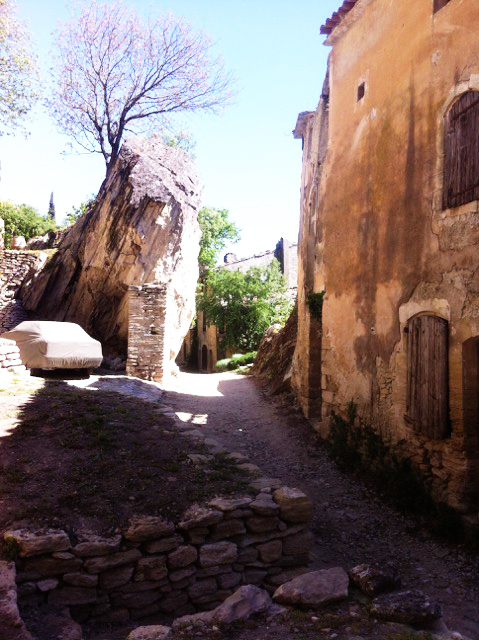
During John Raynes watercolour week the group painted at Oppède le Vieux. Its an exciting place to explore as much of the village is still in its abandoned state.


David stumbled upon the lower floor of an abandoned troglodyte dwelling with an elaborate vaulted ceiling and these beautiful mullioned windows.


Monday, May 9, 2016

The Les Bassacs Team part 1

Liz, Anna and David (photo courtesy of Carol Gillot)

Terry Thompson's week 30th April 2016

Terry's week started bright but suddenly very cold.  We had to put the heating on for a few days.  Then the wind dropped and the sun shone . . .


(Photos courtesy of Terry Thompson)

Thursday, April 28, 2016

All set for the start of the season


We have sunny skies with a strong mistral for the first few days of the season.  It has been exceptionally dry here but the warmth of the sun has brought on the lilacs, poppies and iris.  In the fields there are heavily scented mounds of thyme.  I have been out today,  picking bunches to use in our kitchen this summer.


Saturday, April 16, 2016

Cherry Blossom

The valley is peppered with cherry orchards in full blossom. This year all the trees have flowered  together which makes for a spectacular display. 


There is great variation in the way the cherry trees are pruned which in turn determines the density of the blossom as well as the harvest.  The air is sweet with pollen and it is only six weeks to the cherry harvest!

I am starting researching new recipes for the summer, and today tried this cherry cake recipe from Sweeter Off the Vine by Yossy Arefi.


 Cherry Streusel Cake
Can be made with fresh or frozen cherries


Streusel

35g flour
2 tablespoons old-fashioned oats
2 tablespoons light or dark brown sugar
2 teaspoons poppy seeds
1/4 teaspoon ground cinnamon or cardamom
pinch of salt
2 tablespoons butter, salted or unsalted, at room temperature


Cake

210g flour
1 1/2 teaspoons baking powder
1/2 teaspoon salt
150g granulated sugar
grated zest of 2 large lemons
125ml neutral vegetable oil
3 large eggs
225g plain whole milk yogurt
2 tablespoons freshly squeezed lemon juice
210g pitted cherries, sweet or sour (fresh or frozen)

1. Preheat the oven to 350ºF (180ºC). Butter a 9-inch (23cm) loaf pan, dust with flour, and tap out any excess.

2. Make the streusel by mixing the 35g flour, oats, brown sugar, poppy seeds, cinnamon or cardamom and salt in a small bowl. Add the butter and use your fingers to break the butter into small pieces, until the streusel is in small bits. Set aside.

3. To make the cake, whisk the flour, baking powder and salt together in a small bowl.

4. In a large bowl, rub the sugar and lemon zest together very well with your fingers, encouraging the lemon oil to saturate the sugar. Whisk in the oil, eggs, yogurt and lemon juice. Add the flour mixture all at once, stirring with a rubber spatula until it’s almost completely incorporated. Fold in half of the cherries and scrape the batter into the prepared pan.
5. Dot the remaining cherries over the top and sprinkle with streusel. Bake the cake until golden

on top and it feels set in the center, about 40 to 50 minutes. (You can insert a toothpick in the center to check for doneness as well. When it comes out clean of crumbs, the cake is done.)

6. Let the cake cool on a wire rack. When cool, run a knife along the outside of the cake to help it release from the pan and tip the cake out of the pan.

Storage: The cake will keep for up to three days at room temperature, if well wrapped. You can freeze it for up to two months.


 I had to bake mine for 90 minutes and it didn't rise as well as it should have.  The frozen cherries probably made for a denser cake, but with a delicious, subtle lemony flavour.

Sunday, March 27, 2016

Happy Easter from all of us at Les Bassacs

Lucien Freud had a lifelong love of animals and loved to draw them in all their states including dead and stuffed.  He drew this rabbit in April 1944, perhaps at Easter? I like to think that the rabbit is asleep on the chair. It is a beautiful rendering of his subject in pencil and crayon.

Thursday, March 17, 2016

Keep your bristles soft with Savon de Marseille

 There is always a nice big block of Savon de Marseille next to the sink in the studio. David keeps his oil painting brushes supple by cleaning them thoroughly at the end of each day by rubbing them on the block.
 
The production of this soap is a traditional Provencal industry, dating back to the early middle ages.  Pliny credits the ancient Gauls with the invention of soap which they made with beech ash and goats grease. Thankfully they later moved on to using the abundant olive crop as the source of the grease in the soap!

Savon de Marseille makers used the natural resources of the Carmargue to manufacture their soap - olive oil, sea salt and seepweed from which they extracted soda.  By the Middle Ages Marseille was at the centre of a growing soap industry.  In 1688 Colbert issued a decree that Marseille was to uphold the highest standards in soap manufacture and that the oils used in Savon de Marseille were to be only pure olive oil.

By 1786 there were 48 soap factories many of which were still in operation up until the beginning of the second world war.  Now there are three families still producing the soap in the traditional way : Boetto, Rampal and Marius Fabre.  Only the heat source for the melting process has changed from wood fire to electricity, otherwise the soap is produced in exactly the same way as it has always been. 

The soaps are cut into big blocks which are then air-dried on racks for three months following which the soap is cut into blocks and stamped with its distinctive lettering. 

Remember Savon de Marseille when you are at the market at L'Isle sur la Sorgue.  It is easy to slip in your suitcase and can also be used to wash your laundry, to remove stubborn stains, keep moths out of your clothes and even to bring you good luck!